The New Career Will Be Measured by Skills That Can Be Proven
The labor market is moving toward a new standard of professional trust: skills must be visible, current, and verifiable. As AI, cybersecurity, automation, and skills-based hiring reshape work, certifications and assessments are becoming essential tools for proving readiness. Learning still matters deeply, but career advantage will increasingly depend on the ability to demonstrate what one can actually apply.
9 min.

The labor market is entering a phase in which saying you have a skill is no longer enough. Experience still matters. Academic background still carries weight. Career history still communicates value. But the question employers, executives, boards, and recruiters are increasingly asking is more precise: what competence can be proven?
That is the most strategic reading of Coursera’s Global Skills Report 2025, a report based on data from more than 170 million learners and skills trends across more than 100 countries. The study shows how digital learning has matured: it is no longer only a channel for access to content, but a force shaping employability, hiring, professional mobility, and organizational development. Its message for leaders and professionals is clear: in a market reshaped by AI, cybersecurity, and automation, verifiable skills, micro-credentials, certifications, and assessments are becoming signals of trust.
Competence has become career infrastructure
Generative AI has made visible a reality that was already forming. Skills are aging faster, roles are changing more frequently, and the ability to learn is no longer a motivational slogan. It has become a condition of professional relevance.
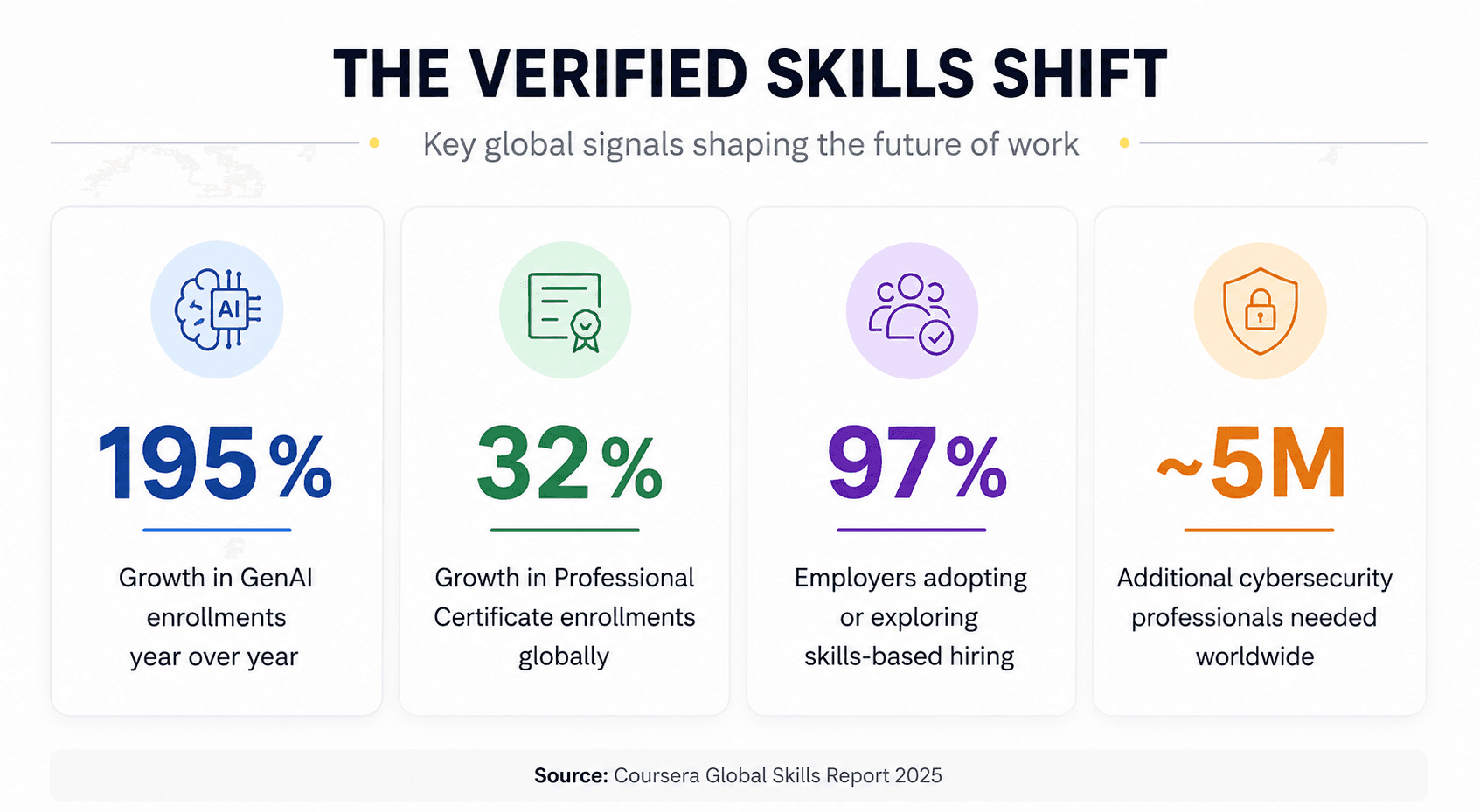
The report shows that GenAI course enrollments grew 195% year over year, surpassing 8 million enrollments. In 2025, Coursera reports 12 enrollments per minute in GenAI content, compared with one per minute in 2023 and eight per minute in 2024. The number matters not only because of its scale, but because of what it represents: professionals and organizations understand that AI is not a peripheral capability. It is becoming an operating language of the new economy.
The broader access to learning is a meaningful achievement. The next challenge is turning that access into professional mastery. The real differentiator will be the ability to apply AI with responsibility, productivity, judgment, and business impact. This is where serious certifications and structured assessments become more relevant: they help distinguish exposure from proficiency.
The résumé is no longer the only proof of value
For decades, the résumé served as the primary document of professional trust. It organized institutions, titles, dates, companies, and responsibilities. That model has not disappeared, but it has lost exclusivity. In an environment where AI tools can produce hundreds of similar applications, generic claims of capability carry less weight.
Coursera’s report states that 97% of employers have adopted or are exploring skills-based hiring, a model that considers verified skills alongside traditional degrees and experience. This is a profound shift. It moves the conversation from “Where did you study?” or “What title did you hold?” to “What can you demonstrate with consistency?”
That shift matters for early-career professionals, experienced executives in transition, organizations trying to reduce hiring bias, and employers facing persistent skills shortages. When competence becomes more visible, the market gains a clearer language for recognizing readiness, potential, and specialization.
Micro-credentials are growing because the market wants evidence
The rise of micro-credentials should not be dismissed as an education trend. It is a response to a real market need. Companies need to identify capabilities faster. Professionals need to signal value more precisely.
According to the report, 91% of employers believe employees with micro-credentials demonstrate higher proficiency in core competencies. Among students, 94% say micro-credentials accelerate career development. The report also shows global Professional Certificate enrollments grew 32%, with positive growth across all regions.
The executive message is clear. The market is not simply asking for more learning. It is asking for learning that is recognizable, traceable, and connected to applicable competence. A certification does not replace experience, maturity, or judgment. But it can add an objective layer of trust. It shows that a professional pursued a defined standard, completed a structured pathway, and accepted some level of validation.
Cybersecurity shows the cost of missing competence
If AI reveals the urgency of upskilling, cybersecurity reveals the cost of skills gaps. The report notes that cybersecurity enrollments increased in multiple regions, including 106% in Latin America, 20% in Europe, and 14% in Asia Pacific. Yet global demand still far exceeds supply, with nearly five million additional cybersecurity professionals needed worldwide.
Boards and senior leaders should read this as a governance warning. Cybersecurity is no longer a purely technical function. It is tied to operational continuity, data protection, customer trust, regulatory exposure, reputation, and institutional resilience.
In this field, missing competence does not simply reduce productivity. It creates risk. That is why certifications and assessments carry even greater weight in critical areas. Organizations cannot rely only on self-declared expertise when the consequences of poor preparation are so high.
Brazil and Latin America: strong demand, execution still ahead
The report offers a particularly relevant perspective for Latin America. The region recorded 425% growth in GenAI enrollments, the highest increase globally, along with 106% growth in cybersecurity and 33% growth in Professional Certificates. These numbers point to strong demand for new skills and rising interest in professional credentials.
Brazil stands out as well. The report identifies 6.5 million Coursera learners in the country, with 242% growth in GenAI enrollments, 111% growth in cybersecurity, and 29% growth in Professional Certificates. Brazil is also positioned as the second economy in Latin America for AI readiness, but the challenge remains converting interest into proficiency, proficiency into employability, and employability into organizational productivity.
That distinction is essential. The Brazilian challenge is not only access to learning. It is the creation of systems that turn learning into validated competence, professional mobility, and economic impact. For companies, this means mapping skill gaps, recognizing relevant credentials, and building advancement pathways based on competence. For professionals, it means choosing learning and certification paths that are connected to the future of work.
The new logic of professional trust
Exent Institute sees this shift as part of a broader transition: from declarative careers to demonstrable careers. A declarative career depends on narrative, titles, reputation, and claims of capability. A demonstrable career combines trajectory with evidence, experience with validation, and ambition with recognizable proficiency.
This transition does not reduce the human value of work. It makes professional judgment even more important. In a world where AI increases content production, automates tasks, and accelerates workflows, the difference will be the ability to apply knowledge responsibly, interpret context, make decisions under uncertainty, and sustain standards of excellence.
Certifications, assessments, and micro-credentials are not the final destination of competence. They are instruments. Their value depends on the seriousness of the criteria, the relevance of the skills being assessed, and the connection to real market problems. When designed well, they help companies hire better, promote with greater clarity, develop talent with focus, and recognize professionals whose capabilities might otherwise remain invisible.
Learning matters, but proof will decide
The next stage of professional growth will not be defined only by the volume of courses, titles, or keywords on a résumé. It will be defined by the ability to demonstrate, clearly and consistently, what one knows how to apply.
The Global Skills Report 2025 reinforces that the world of work is moving toward a more skills-based, credential-aware, evidence-driven model. This model is still evolving, with challenges around quality, equity, and interpretation. But its direction is unmistakable: the market will increasingly value competencies that can be recognized, compared, and mobilized.
For professionals, the recommendation is to manage the career as a project of provable competence. For companies, it is to treat skills not as a training topic, but as infrastructure for strategy, risk, and growth. For institutions working in certification and assessment, the responsibility is even greater: to build credible standards so professional merit can be seen, validated, and recognized.
In the new labor market, learning is only the beginning. The real advantage will come from transforming learning into competence, competence into evidence, and evidence into trust.